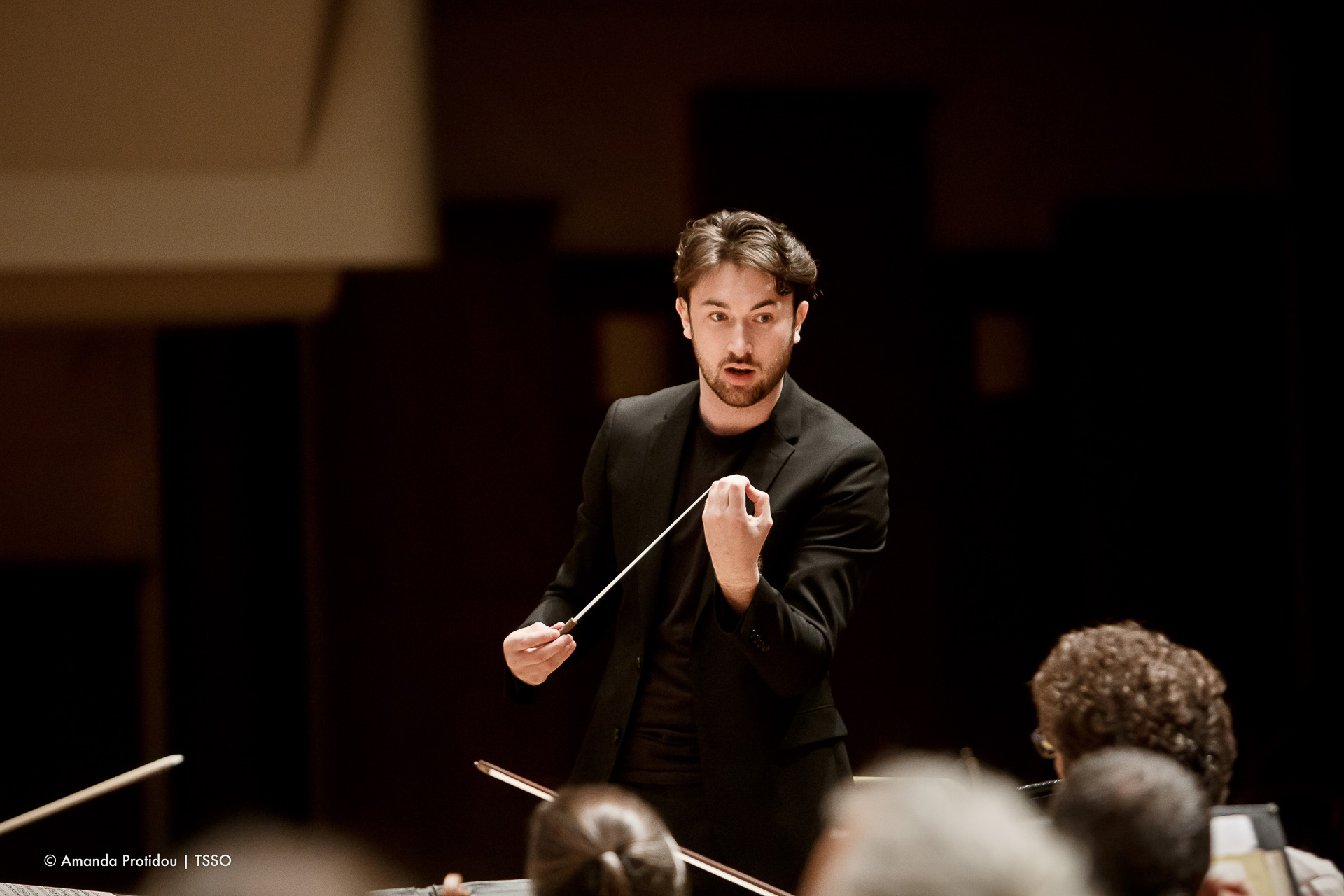
Introducing our new Principal Conductor
Today we welcome Oliver Cope as he joins Chromatica Orchestra as our first Principal Conductor.
A prize-winning harpist and pianist, 27-year-old Oliver read music at the University of Cambridge before studying conducting at the Royal Academy of Music and at the Royal Conservatoire of Scotland and winning prizes at numerous international conducting competitions, including the BR-KLASSIK studio production prize with the Bamberg Symphony at the 2026 Gustav Mahler Conducting Competition. He has conducted orchestras across the UK and Europe including the Hallé, BBC Scottish Symphony Orchestra, Royal Scottish National Orchestra, Bournemouth Symphony Orchestra, Bamberg Symphony, Mozarteum Orchestra Salzburg, Sønderjyllands Symfoniorkester and Thessaloniki State Symphony Orchestra and recently appeared at Battersea Arts Centre conducting Stravinsky’s The Rake’s Progress for British Youth Opera.
Ahead of his first concert with us at Battersea Arts Centre on 14 October, we asked Oliver to tell us a bit about his musical life so far and the plans his has for his time with Chromatica Orchestra.
Congratulations on being appointed as Chromatica Orchestra’s very first Principal Conductor. What excites you about the orchestra and what are you most looking forward to about taking on this new role?
What’s exciting is that Chromatica is such a young, dynamic orchestra, and the standard of playing is already extremely high. But for me the bigger opportunity is that we’re at a stage where we can decide what sort of orchestra we want to be.
London isn’t short of excellent orchestras, so if you’re starting something new, I think you need to have a reason for existing. I’m interested in being ambitious about the playing, obviously, but also in asking what else a concert can be. What happens around the music, and what does the evening feel like from the moment somebody walks through the door? And how do you give someone who wouldn’t normally come to an orchestral concert a reason to try one? That’s the kind of thinking I want to be at the heart of what we do.
In my first few weeks I’ve had lots of conversations with the management and players, and what’s struck me is that there’s a real appetite for that throughout the orchestra. People want to try things, and that’s exciting.
Battersea Arts Centre is a big part of it too. It’s a building known mainly for theatre rather than classical music, and it isn’t a traditional concert hall at all. That gives us quite a lot of freedom. There’s something slightly adventurous about regularly putting a full orchestra into that space, and I’m looking forward to seeing what we can do with it.
For those who don’t know you yet, tell us a little about Oliver Cope. What was your musical life like growing up, and when did you realise that music was going to be your career?
Both my parents were musical, although neither of them was a professional musician. We had a piano in the house, and I remember spending a lot of time just messing about on it, improvising and making up silly little tunes.
The harp came along a bit later and became my main instrument throughout childhood and my teens. I realised fairly early, probably when I was eight or nine, that music mattered to me more than most things did.
I’m not sure there was ever one dramatic moment when I decided it was going to be my career. It was more that, as I got older, it became increasingly difficult to imagine doing anything else.
Who or what are the biggest musical influences and inspirations in your life?
My mother, without question. She studied music and had her own musical aspirations when she was younger, but when I was growing up she was working as a journalist. She was hugely supportive of me and, through that, found her own way back to music professionally.
She now teaches piano, spent some time working as a music therapist, and writes fiction centred around classical music. It’s been lovely that while I was discovering music, she was also rekindling her own relationship with it. I owe her a great deal.
On the conducting side, two people stand out. Carlos Kleiber, the great German-born Austrian conductor, is probably a fairly predictable answer, but there’s a reason so many conductors say it. Nobody had quite that charisma on the podium. You can watch him conduct something you’ve heard a hundred times and somehow it feels as though it’s being invented on the spot.
The other is Tugan Sokhiev, who I think is one of the most brilliant conductors working today. I’m fascinated by the economy and clarity of his gesture, and by the way he shapes the sound of an orchestra. They’re two conductors I admire enormously.
Did you always know that conducting was what you wanted to do, or did that ambition develop later?
Music, yes, pretty much from the start. Conducting came a bit later.
When I was about fourteen or fifteen, I was playing harp in adult amateur orchestras, and I quickly worked out that I was a bit of a bargain because I was playing for free. So I made a deal with them: I’d keep playing for nothing if they let me have a go at conducting.
That’s really where it started. When I was sixteen, I put together an orchestra of young musicians from local schools so that I could conduct more regularly. Then I started another orchestra at Cambridge, and I didn’t actually have a conducting lesson until I was twenty-two. So most of my early learning came from standing in front of orchestras and working things out as I went along.
I think there’s something valuable in learning that way. You find out very quickly what doesn’t work, which in some ways is more useful than being told what does. If something you do isn’t helping the musicians in front of you, you have to find another way of communicating it.
You’ve had some fantastic successes in conducting competitions in recent years. What do you enjoy about the competition experience – and what have you learnt from it?
Honestly, “enjoy” isn’t quite the right word. They’re extremely high pressure. You might get ten or fifteen minutes with an orchestra you’ve never met, with a jury sitting behind you and sometimes hundreds of people watching online. It’s a slightly strange way to make music.
I’ve been fortunate to have some very good results, and the experience has taught me a huge amount. When you’ve only got ten minutes, you find out very quickly what actually matters in the music. You have to listen, communicate clearly and make decisions under pressure.
You also get to work with lots of different orchestras and receive honest feedback from conductors and musicians you might otherwise never meet.
There’s that line attributed to Bartók, “Competitions are for horses, not artists”, and I do think there’s something inherently strange about ranking artistic performances. But I have no doubt the experience has made me a better conductor.
Looking ahead to our forthcoming concerts, can you give us a taste of the music you’ve chosen and what audiences can look forward to?
The first concert brings together three pieces that have an incredibly cinematic quality, even though only one of them was actually written for film.
At the centre are two works written in exactly the same year, 1945, but in completely different worlds. Shostakovich’s Ninth Symphony came right at the end of the Second World War, when Stalin and the Soviet authorities were expecting something enormous, essentially a Soviet answer to Beethoven’s Ninth.
Instead, Shostakovich gave them something about twenty-five minutes long, mischievous and at times almost farcical. It was absolutely not the great victory monument they were expecting, and it went down accordingly.
Korngold, meanwhile, was in Hollywood. His Violin Concerto gave him a chance to return to concert music after years working in the film studios, and it’s lush, romantic and completely unapologetic about it. Our soloist is Sarang Seohyun Kim, a hugely exciting young South Korean violinist who turns eighteen on the actual day of the concert, which makes it a particularly nice occasion.
Then there’s Bernard Herrmann’s Psycho Suite, which is the only music on the programme actually written for the screen. But all three pieces are so vivid that you can almost see something while you’re listening to them. There’s a nice historical thread through it too. The sound Korngold helped create in Hollywood became hugely influential on later film music, and you can hear that legacy clearly in composers like John Williams.
In November we go somewhere completely different with a tango-inspired evening featuring Ryan Corbett, one of the most exciting young accordionists working today.
I’m also excited about how we’re presenting these first concerts. There are a few surprises I can’t give away yet, but the basic idea is that the evening should start when you walk through the door and get your pre-concert drink, not when I walk onto the podium.
If there were no limits on budget, time or logistics, what would be your dream project to create with Chromatica Orchestra?
One would be a huge immersive production of a major orchestral work, something like Strauss’s An Alpine Symphony or John Adams’s Harmonielehre, with lighting, staging, the works. I’d love to take a piece on that scale and think about the whole thing theatrically from the beginning, rather than treating the visual side as something you add afterwards.
Finally, when someone leaves a Chromatica Orchestra concert, what would you love to hear them saying on their way home?
I’d love them to say, “That was different. That was original. That was fresh.”
I don’t mean that everything has to be different for the sake of it. The music always has to come first. But I want there to be real energy and purpose behind what we do, and a sense that the audience has experienced something rather than simply attended something.
If somebody leaves feeling they’ve had an evening they weren’t quite expecting, and they’re still talking about it on the way home, that’s a pretty good result.